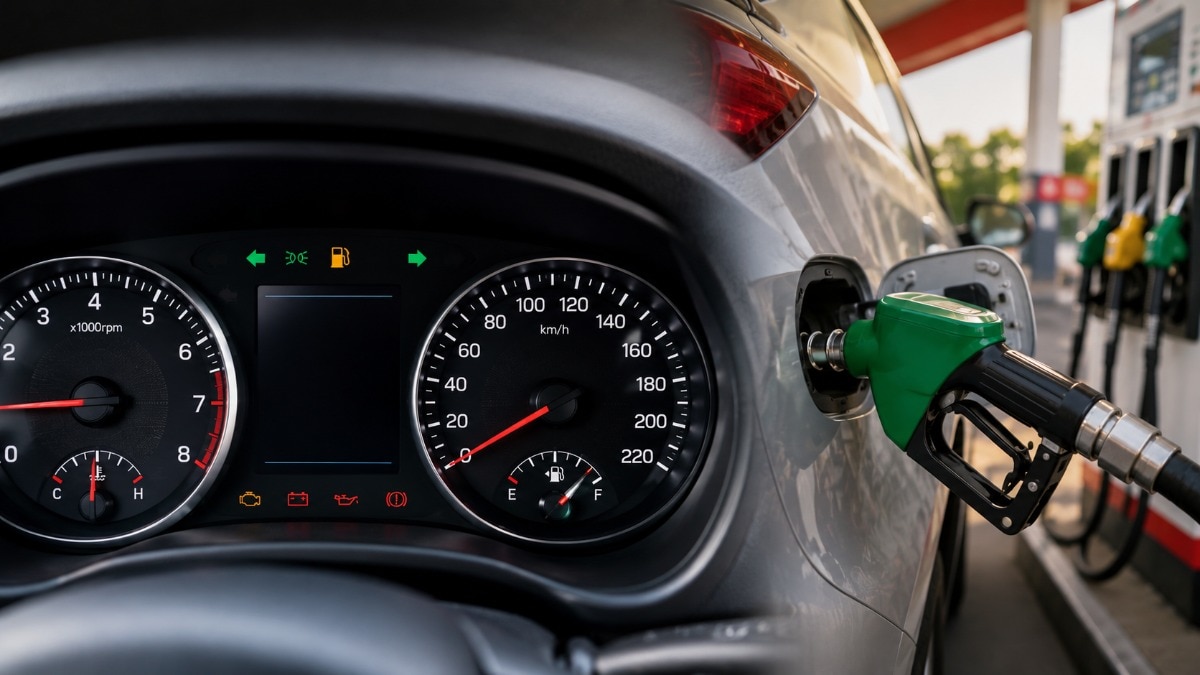
GK: Why do car speedometers go up to 220 km/h even though you can't drive that fast?
Ever noticed that even a modest hatchback capable of a top speed of around 150 km/h often has a speedometer that stretches all the way to 220 km/h or even 240 km/h? It’s a detail most drivers overlook, but there’s a fascinating reason why carmakers do it.The biggest reason is standardisation. Instead of designing a different speedometer for every variant of a car, manufacturers often use the same instrument cluster across multiple models. A higher-performance version of the same vehicle may actually be capable of much higher speeds, making it more economical to use one speedometer for the entire range.There’s also a technical reason. Speedometers are designed to be most accurate in the speed range where people drive the most—typically between 40 km/h and 120 km/h. If the dial ended at 140 km/h, the markings would be packed too closely together, making it harder to read your speed quickly. Extending the scale to 220 km/h allows for better spacing and easier readability.Psychology plays a role too. For decades, automakers have associated higher numbers with performance. Even if a car can never reach 220 km/h, a speedometer with a higher limit subtly gives the impression of a more capable, premium vehicle. It’s one reason sports cars often have speedometers reading 300 km/h or more, even though very few owners will ever see those speeds.In India, the reality is very different. Most expressways have speed limits ranging from 100 to 120 km/h, while city roads allow much lower speeds. Driving anywhere close to 220 km/h would not only be illegal on public roads but also extremely dangerous. In everyday use, most drivers spend almost all their time well below the halfway mark on the dial.So, the next time you glance at your car’s speedometer and wonder why it promises speeds you’ll probably never achieve, remember: it’s less about encouraging fast driving and more about manufacturing efficiency, better instrument design and a little bit of automotive psychology. It’s one of those tiny details hiding in plain sight that most of us never stop to question.
2026-08-04T14:26:36Z